
Fallout Pinball Review


Fallout is one of those pinball machines that immediately makes you stop and look at the playfield.
Not because it is simply packed with toys, but because the whole layout feels different. There are ramps coming from unexpected places, unusual shots, strange angles, an inverted flipper, a lower playfield controlled by a magnet, and mechanical features that make you wonder how someone even came up with the idea in the first place.
Designed by Keith Elwin, Fallout takes the enormous world of the Fallout games and TV series and turns it into something that actually feels like pinball rather than simply putting a Fallout theme on a conventional machine.
And after spending time looking at the game, the biggest impression is surprisingly simple:
Fallout is a very original pinball machine.

Gameplay
The first thing that stands out about Fallout is how naturally the machine encourages you to shoot.
There are plenty of things to aim for, but the layout doesn't feel like a collection of isolated gimmicks. The shots connect with each other, the ball moves around the playfield in interesting ways, and there is always another shot that makes you want to try again.
This is one of those machines where you can start playing without completely understanding the rules and still have fun.
Then, as you learn the game, you begin to understand why certain shots are positioned where they are and how the different features interact.
That is one of Keith Elwin's greatest strengths as a designer: making a machine that feels interesting before you fully understand it.
We previously looked at Fallout as one of the most original pinball machines in years, and playing the game only reinforces that impression.
Layout & Flow
This is probably the strongest part of Fallout.
The layout is completely original.
There are ramps everywhere, but they don't all behave like the conventional ramps you expect to see on a modern pinball machine.
One of the most interesting is the ramp on the right. It is partially hidden, so you don't immediately see exactly where the ball is going. It comes up and over the playfield in a way that makes the shot feel almost mysterious.
Then there is the central Vault area.
The way the Vault opens and moves to the side so that you can send the ball into it is extremely clever. Visually, it feels almost as if the playfield continues backwards into the machine. It is a simple idea, but the physical movement makes the whole area feel much deeper.
The Pip-Boy is also positioned beautifully.
It sits far enough away that it doesn't constantly get in your way while playing, but it is still highly visible. It becomes part of the visual identity of the machine without dominating the playfield.
And then there is that strange area on the left.
The left outlane has been designed around a pop bumper in a way that creates a very unusual interaction. Instead of simply being an area where you hope the ball doesn't drain, the ball can get into a little battle with the geometry and bumper before finally deciding where it wants to go.
It adds another layer of unpredictability — but, importantly, it feels like fun unpredictability.

The Fat Man Cannon
The Fat Man launcher might be one of the most interesting mechanical ideas on the machine.
The ball is launched from the left side, travels a surprisingly long distance and arcs upwards before landing on the upper platform.
It doesn't simply fire the ball straight across the playfield.
The trajectory itself is part of the fun.
This is the kind of mechanism that makes you look at the machine and think: I've never seen a pinball shot quite like that before.
The V.A.T.S. system adds another layer to the launcher, making the mechanism feel even more integrated into the Fallout theme.
The Inverted Flipper
Then there is the famous inverted flipper.
Reverse flippers are not technically a completely new invention — they have appeared before, particularly in older pinball — but you almost never see this kind of feature on a modern major release.
And that is exactly why it feels so fresh here.
It changes the way you think about that part of the playfield. Instead of simply giving you another conventional shot, Elwin has created an entirely different relationship between the ball, the flipper and the surrounding geometry.
It is a small piece of the layout, but it says a lot about the philosophy behind Fallout.
The designer wasn't afraid to do something weird.
The Loop
One of the shots I particularly like about Fallout is the loop shot from the inverted flipper.
It is a beautiful piece of design because the ball remains visible for long enough that you can actually understand what it is doing as it comes back towards the inverted flipper.
And once you get the timing right, you can repeat the loop.
That is an important distinction.
A spectacular shot that you can only make occasionally is fun. A spectacular shot that you can learn, control and repeat is great pinball.
Fallout has several moments like this where the game rewards you for understanding the geometry rather than simply hoping for a good result.
Rules & Code
Fallout is also trying something interesting from a software perspective.
Rather than simply using the Fallout universe as a collection of characters and references, the game builds progression around the RPG nature of the franchise.
Characters, abilities, missions, exploration and progression all become part of the experience.
The S.P.E.C.I.A.L. system is particularly interesting because it gives the game an RPG-style progression layer while still leaving the actual pinball at the centre of the experience.
That is important.
Fallout could very easily have become a game where you spend more time following instructions than actually shooting the ball. Instead, the layout remains the star.
And the game is still very new, so this is one area where it will be fascinating to see how much further the code develops.
Early Pinside feedback is already very positive overall, with several players praising the shot variety, flow and Elwin's ability to make people actually play pinball. At the same time, some players have criticised the long video sequences and questioned how much impact certain mechanisms currently have. That is exactly the sort of thing that can change substantially as the code develops.

Theme & Artwork
Fallout's artwork is excellent.
It manages to pull from both sides of the Fallout universe — the games and the television series — without making the machine feel visually confused.
The playfield is colourful, varied and full of little details.
The inserts are particularly good, and the combination of colours, characters and environmental elements gives the playfield a lot of personality.
But what I like most is that the artwork actually feels appropriate for pinball.
It isn't trying to make the playfield look like a movie poster.
It is designed to work with the geometry of the machine.
The Pip-Boy is a perfect example. It is an unmistakable Fallout object, but its position also works beautifully from a pinball perspective.
And then there is the rest of the world: Vault-Tec, the Wasteland, characters, enemies and all those little visual references that make you want to keep looking at the machine.
We've already started building our own Fallout pinball mods, because this is exactly the kind of machine where custom artwork can take things to another level.
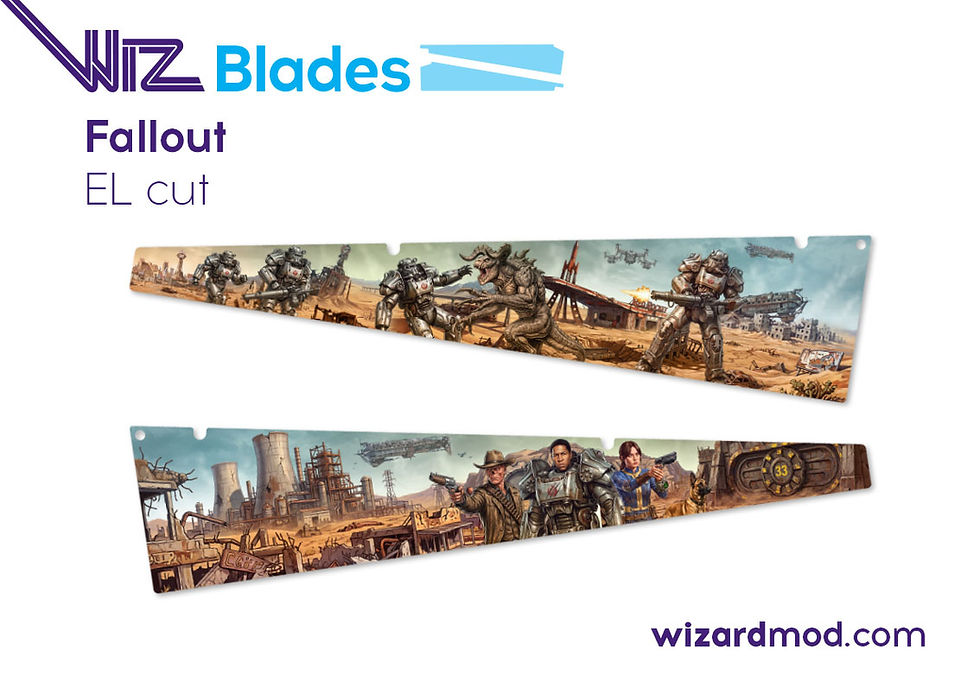
Our Fallout EL Cut WizBlades extend the artwork into the inside of the cabinet, turning what would otherwise be a large black area into another part of the Wasteland.
And for collectors who want an even more dramatic effect, there are also our Falout LE WizPanels.
The artwork is one of those areas where Fallout is already strong — and customisation makes it even better.
Sound & Atmosphere
The atmosphere is another major success.
Fallout has an enormous amount of material to work with, and the machine makes good use of that world without turning every second into noise.
The audio, music, callouts and video work together to create the feeling that you are actually progressing through a Fallout adventure.
And some of the combinations are particularly entertaining.
One of the early Pinside comments even singled out the contrast of playing multiball while Glenn Miller's In the Mood is playing — exactly the kind of unexpected Fallout moment that fits the universe so well.
Pro vs Premium vs LE
This is where things get complicated.
The Pro, Premium and LE are not simply three cosmetic versions of the same machine.
The Premium and LE add some major physical features, including the lower Vault playfield with Magna-Flip, the Fat Man launcher and Wasteland Shooting Gallery, and the functional Vault door. The Pro replaces some of these elements with simpler alternatives.
The lower playfield is particularly interesting.
It feels like a completely different little pinball challenge inside the main game. The ball is controlled with the magnetic flipper, and the whole thing is compact, difficult and surprisingly entertaining.
It doesn't feel like an afterthought.
It feels like another game hidden inside Fallout.
For me, the Premium/LE experience is therefore the more complete version of Fallout. The Pro still has the excellent main layout — and several Pinside owners clearly love it — but once you have played the Premium or LE, it is difficult not to notice what is missing.
That said, the Pro does have one advantage: because the main playfield is still so good, it doesn't suddenly become a bad game.
It is still Fallout.
It just isn't quite the same Fallout.
Who Is This Machine For?
Fallout is for players who like original pinball.
If you want a machine that immediately makes sense because you've seen the same layout ten times before, this probably isn't it.
But if you enjoy learning unusual shots, discovering strange interactions and gradually understanding why a designer put something in a particular place, Fallout is extremely rewarding.
It is also a great machine for Fallout fans because the theme has been treated seriously.
You don't need to know every detail of the games or television series to enjoy the pinball, but if you do know the universe, there are plenty of things to discover.
And for collectors who care about artwork, Fallout is an especially strong candidate for customisation. Our complete Fallout Pinball Mods collection gives you plenty of ways to extend that visual identity across the machine.
Final Verdict
Fallout is a very impressive pinball machine.
More importantly, it is an interesting pinball machine.
The layout is the star. The hidden ramp, the Vault, the unusual left-side geometry, the inverted flipper, the Fat Man cannon, the loops and the lower Magna-Flip playfield all contribute to a game that feels like someone genuinely tried to do something different.
And that is becoming increasingly rare.
Keith Elwin has once again designed a machine that makes you want to shoot the ball simply to find out what happens next.
The artwork is colourful and full of personality. The theme integration is excellent. The mechanical features are memorable. And the game has enough depth that it should continue revealing itself as the code develops.
There are some things that could improve — particularly the pacing of some video sequences and the balance between the different model versions — but those are relatively small complaints compared with the fundamental strength of the game.
Fallout is original, inventive and, most importantly, fun to play.
For me, that is the biggest compliment you can give a pinball machine.
And when you combine that unusually good layout with the visual potential of Fallout custom pinball art, you end up with one of the most interesting new Stern machines in years.


Comments